
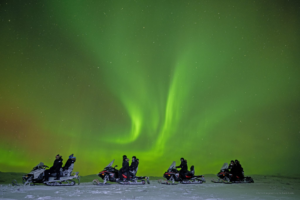
Aurora Forecast for Kiruna: Your Ultimate Guide to Seeing the Northern Lights in Sweden
Can you see the Northern Lights in Kiruna tonight? If the sky is clear, you are visiting between September and April, and you check a reliable Aurora Forecast for Kiruna, the answer is very likely yes. Kiruna is located directly under the “Auroral Oval,” making it one of the most reliable places on Earth to witness the Aurora Borealis.
To catch the lights, you need three things: solar activity, darkness, and clear skies. In this guide, we provide a live Kiruna sky camera, the latest Aurora Forecast for Kiruna data, and local secrets to help you time your chase perfectly.
KIRUNA AURORA MONITOR
Fetching live satellite data...
In Kiruna, you don't need a high KP index. Even a KP 1 can create a visible green arc on a clear night!
Understanding the Forecast: What do the numbers mean?
When you look at an aurora forecast for Kiruna, you’ll see several technical terms. Here is what they actually mean for your night out:
The KP Index (The “Volume” of the Lights)
The KP Index is a global scale from 0 to 9 that measures geomagnetic activity. While people further south in Stockholm or Germany need a high number to see anything, Kiruna’s location is a “cheat code” for Aurora hunters.
- KP 0–2: Quiet Activity (The “Kiruna Special”) Even at the lowest levels, the Northern Lights are often visible in Kiruna. You can expect elegant green arcs or a soft “glow” along the northern horizon. Because we are directly under the Auroral Oval, a KP 1 here can look better than a KP 5 in London!
- KP 3–4: Active (The Dancing Lights) This is the “sweet spot” for photographers. The Aurora becomes more dynamic, moving across the sky in curtains. You’ll see brighter greens and potentially flashes of pink or white as the lights begin to “dance” and pick up speed.
- KP 5+: Geomagnetic Storm (The “Big Show”) When a solar storm hits, the Aurora expands south, and the display in Kiruna becomes overhead and intense. This is when you see the “Corona”—where the lights appear to explode from a single point above you—showering the sky in vivid greens, deep purples, and rare crimson reds.
The Bz (The Magnetic “Doorway”)
If the KP index is the “volume” of the music, the Bz is the “power switch.”
The Bz measures the direction of the magnetic field from the Sun. For the Northern Lights to appear, the Sun’s magnetic field needs to “snap” onto Earth’s magnetic field like two magnets connecting.
Negative Bz (Southward): The door is OPEN. This is what you want! Solar particles can pour into our atmosphere and create the lights.
Positive Bz (Northward): The door is CLOSED. Even with a high KP index, the lights might stay quiet because the particles are being repelled by Earth’s shield.
Cloud Cover (The “Curtain”)
You can have the strongest solar storm in a decade, but if the “curtain” of clouds is closed, you won’t see a thing. The Aurora happens roughly 100km to 600km above the Earth, while clouds sit much lower (usually under 10km).
How to Beat the Clouds in Kiruna
The weather in the Arctic is localized and changes fast. If it’s snowing in Kiruna town, it might be perfectly clear 30 minutes away. This is why “Chasing” the lights is so effective.
The “Blue Hole” of Abisko: About an hour from Kiruna, Abisko National Park has a unique micro-climate. The surrounding mountains often push the clouds away, creating a “hole” of clear sky even when the rest of Lapland is overcast.
Check the Stars: A simple trick—if you can see the stars, you can see the Aurora. If the stars are blurry or missing, you are looking at clouds.
Satellite Maps are King: Don’t just look at the “Sun/Rain” icon on your weather app. Look at the Cloud Cover Map (we recommend Yr.no or SMHI for Kiruna). White means clear, grey means stay by the fire!
Live Kiruna Sky Monitor
Real-time view from the IRF Space Campus Observatory.
Is it dark? This camera only shows the sky during night hours. If the box above is black/grey, it's either perfectly clear or daytime in Kiruna!
Open Full Observatory FeedWhere are the Best Places to See the Aurora in Kiruna?
You don’t always need a tour to see the lights, though they help you find clear skies if it’s cloudy in town. If you are staying in the city center, here are the best “self-chase” spots:
Camp Ripan / Midnattssolstigen: A short walk from the center, this area has lower light pollution and a wide-open view of the northern horizon.
Mount Luossavaara: If you’re up for a hike (or a drive in winter), the top of the local ski hill offers a 360-degree view of the Arctic landscape.
Jukkasjärvi (The ICEHOTEL): Just 20 minutes away, the frozen Torne River provides a massive, dark stage for the lights.
Abisko National Park: Often called the “Blue Hole,” Abisko (an hour away) has a unique microclimate that keeps the skies clear even when Kiruna is cloudy.
The Reality of the Aurora Forecast for Kiruna: Data vs. Sightings
Understanding the Aurora Forecast for Kiruna is the first step toward seeing the lights, but data alone is only 50% of a successful hunt. The biggest mistake visitors make is trusting an app, seeing a “cloudy” icon, and staying in their hotel. In the Arctic, the difference between a “disappointing night in the lobby” and a “night under the dancing lights” is almost always mobility.
Here is why the forecast isn’t the whole story:
- The Cloud Trap: A live camera might show heavy clouds in Kiruna town, but the professional chase teams we represent are experts at finding “Blue Holes”—pockets of clear sky that can exist just 30 minutes away.
- The Timing Gap: By the time a “Level 5” sighting is reported on a community app, the peak of the display is often already over. Local guides use real-time data from the Swedish Institute of Space Physics (IRF) to get you in position before the lights explode.
- The Local Edge: From the Abisko mountains to the Norwegian border, our vetted guides know which frozen lakes have the best microclimates for a clear view at 11:00 PM—a skill that takes years to master.
Because the Aurora is a natural (and sometimes shy) phenomenon, we always recommend staying at least 3 nights in Kiruna to maximize your chances. Arctic weather changes in minutes, and multiple nights give you the flexibility needed to catch that perfect window.
When you book through Discover Kiruna, you aren’t just buying a seat; you are securing a spot with the region’s premier experts. Many of our tours provide professional photography tips and heavy-duty thermal gear to keep you comfortable during the long wait. Pro Tip: Since every expedition is unique, be sure to check the “What’s Included” section of your chosen tour to see specific details on gear, transport, and snacks.

Electric Snowmobile Aurora Tour in Abisko
Explore the Arctic in a sustainable and peaceful way. Our Electric Snowmobile Aurora Tour Abisko offers a silent journey through quiet valleys in search of the Northern Lights.
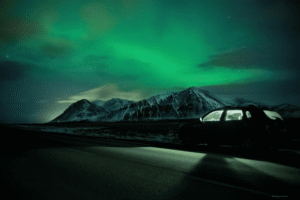
Northern Lights Car Chase
Set out on a thrilling adventure with our Northern Lights Car Chase. We drive away from light pollution to carefully selected spots, maximizing your chances of witnessing the breathtaking Aurora Borealis.
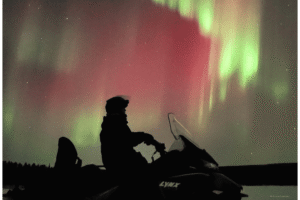
Snowmobile Aurora Expedition with dinner
What’s better than experiencing the northern lights in Swedish Lapland? Doing it while driving a snowmobile, of course! Join our popular tour as we explore under the vast Arctic night sky.
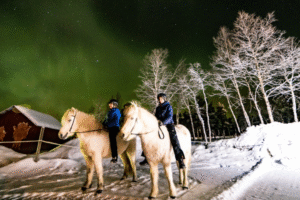
Northern Lights Tour on Horseback
Ride your Icelandic horse tour under the silent, starry sky and experience the ultimate relaxation in this northern lights tour on horseback in Kiruna.
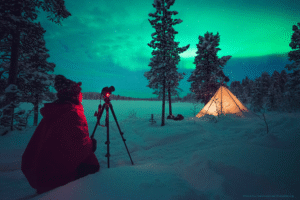
Northern Lights Photo Tour
Capture the magical Arctic night! This evening tour is designed for guests of all skill levels, we make sure you have the knowledge and equipment to capture stunning images of the Aurora Borealis and the Arctic night.
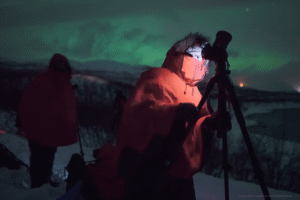
Aurora Tour with Dinner in Abisko
Combine dining and chasing. The aurora tour with dinner in Abisko offers High-end Northern Lights dining before searching for the lights.
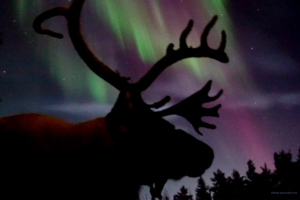
Sami Northern Lights Tour
Search for the Aurora on a silent, traditional reindeer sledding night tour near Jukkasjärvi. Experience the quiet Arctic magic.
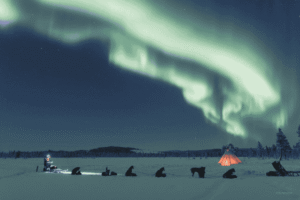
Northern Lights Husky tour
Chase the Aurora Borealis on a guided Northern Lights Husky tour evening tour outside Kiruna. Enjoy the silent wilderness and spectacular night dogsledding Aurora experience.
Frequently Asked Questions (FAQ)
What is the best month to see the Northern Lights in Kiruna?
The season runs from late August to early April. The “best” months are often September/October and March because of the equinoxes, which statistically have higher solar activity. However, December and January offer the most darkness.
What time of night is best?
Typically, the peak hours are between 20:00 (8:00 PM) and 02:00 (2:00 AM). However, if a solar storm hits, the lights can appear as soon as it gets dark.
Do I need a professional camera?
Modern smartphones are surprisingly good! Use “Night Mode” and a small tripod. For professional results, you’ll want a DSLR with a wide-angle lens and a high ISO setting.
How accurate is the Aurora Forecast for Kiruna?
The forecast is very accurate for predicting solar activity (KP Index), but local weather is the wild card. We recommend checking the forecast every 30 minutes once darkness falls, as the Bz index can “flip” quickly, triggering a display.
Can I see the Northern Lights from Kiruna city center?
Yes! If the activity is strong (KP 3+), you can see them even with streetlights. However, for the best photos and to see the faint colors, we recommend joining a tour to escape the “light pollution” of the mines and town.
Do I need a car to see the Aurora in Sweden?
While not strictly necessary if you stay near dark spots, having a car or joining a guided chase significantly increases your odds. It allows you to move away from local cloud cover, which is the #1 reason people miss the lights.
What should I wear for an Aurora chase?
Temperatures in Kiruna can drop to -30°C. We recommend the “Layering Principle”: wool base layers, a warm fleece or wool mid-layer, and a windproof/waterproof outer shell. Don’t forget high-quality insulated boots!
If you need help packing, you can see our complete guide on what to wear in Kiruna here.